
PhD thesis · University of Edinburgh · 2022
[Thesis] Generative Factorization for Object-Centric Representation Learning
How can a model discover the objects composing a scene from images alone? My PhD thesis studies generative factorization as a route to object-centric representation learning, recovering scene structure without object-level supervision and separating properties of the scene from the conditions under which it is observed.
From latent variables to scene structure
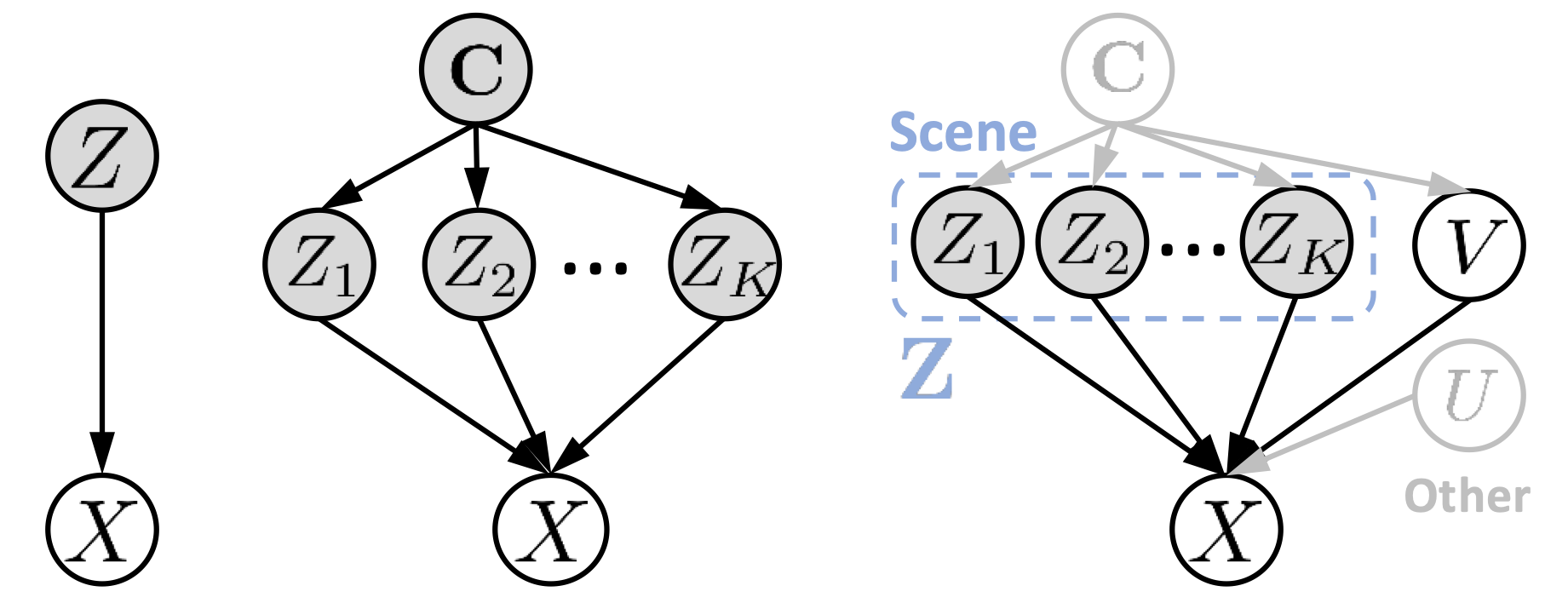
Three complementary directions
- MulMON aggregates multiple views into a shared set of object representations. Predicting new viewpoints encourages these representations to resolve ambiguities in individual images.
- Latent duplicate suppression (LDS) addresses redundant object representations, helping the model avoid explaining the same object with multiple latent components.
- DyMON extends object-centric learning to dynamic scenes, factorizing changes caused by camera motion and by object dynamics.
Together, these directions connect scene decomposition with generative prediction: representations can be queried from new viewpoints and, in the dynamic setting, across time. The thesis develops this progression from multi-view observations towards structured models of changing scenes.